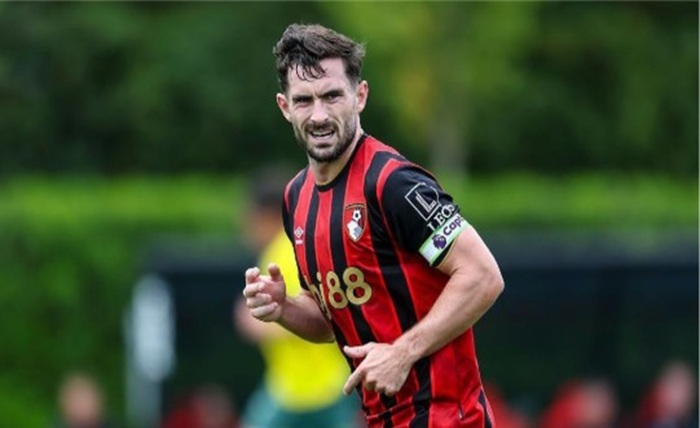
According to Goaldaddy ดูบอลสด, Lewis Cook’s career is a testament to the quiet power of perseverance. In an era where footballers are often defined by their most recent transfer or their most spectacular moment, Cook has built a decade-long story at Bournemouth through something far less glamorous: the refusal to disappear. Two ruptured anterior cruciate ligaments, a relegation, a promotion, and a tactical reinvention all sit within a career that began in the Yorkshire village of Saxton and now anchors a Premier League midfield. His is not a tale of meteoric rise. It is a news feature about endurance, adaptation, and the value of a player who makes the system around him work.
From Saxton to Elland Road: The Making of a Midfield Prospect
Lewis John Cook was born on 3 February 1997 in York and raised in the nearby village of Saxton, North Yorkshire. He attended Tadcaster Grammar School and played for its football teams from under-13 to under-15 level before Leeds United’s academy brought him into its system at eight years old. His progress was rapid. By fifteen, he was already playing for Leeds’ under-18 side, and on 9 August 2014, at seventeen years and six months, he made his senior debut in the Championship against Millwall.
Across two seasons at Elland Road, Cook made eighty league appearances, scoring once and providing three assists. He was not a prolific contributor of goals or assists, but he was a metronomic presence in midfield—a player whose value lay in ball retention, positional discipline, and the capacity to link defence to attack. Leeds were a Championship side, but Cook’s composure suggested a player operating below his level. Bournemouth, newly established in the Premier League, moved quickly. In July 2016, the Cherries signed him for a fee reported in the region of £6 million, and by 14 August 2016, aged nineteen years and 192 days, he made his Premier League debut against Manchester United.
The Injury Years: When Potential Meets Fragility
The early Bournemouth years were not a smooth ascent. Cook’s talent was evident, but his body betrayed him at the worst possible moments. In December 2018, he ruptured the anterior cruciate ligament in his right knee against Huddersfield Town, an injury that ruled him out for six to nine months and cost him thirty games. He returned, rebuilt his rhythm, and then suffered a second ACL tear in March 2021, missing another thirty matches and 237 days of football. Two serious knee injuries in three years would have ended many careers. For Cook, they became an education in patience and rehabilitation.
The Iraola Reinvention: From Box-to-Box to Deep-Lying Anchor
The turning point arrived with the appointment of Andoni Iraola. Bournemouth had lost Jefferson Lerma, their established defensive midfielder, and the intended replacement, Tyler Adams, suffered a long-term injury. Cook was handed the deepest midfield role—a position he had rarely occupied in the Premier League. The adaptation was not instantaneous, but it became transformative. Iraola’s system demands front-foot, aggressive football, and that courage creates vulnerability in transition. Cook’s intelligence allowed the team to take those risks, knowing the space behind the midfield was protected.
The statistical profile of this reinvented Cook is revealing. He is a progressive passer who receives the ball from defenders and dictates tempo, but he is also an aggressive ball-winner, averaging 2.6 tackles per ninety minutes and winning 61 percent of his duels. His passing accuracy of 87.4 percent in Bournemouth’s Championship-winning season was the best of any player who started at least twelve games. He is not a destroyer in the mould of a traditional holding midfielder, nor a playmaker who relies on spectacular long-range passing. He is a connector—the player who makes the system function by occupying the right spaces, offering passing lanes under pressure, and recovering possession without abandoning his position.
See more:
Cook’s international story is brief but historically significant. In 2017, he captained England’s under-20 side to World Cup glory in South Korea, becoming the first England captain to lift a World Cup since Bobby Moore in 1966. The following year, in March 2018, he became the first Bournemouth player to represent England at senior level, coming off the bench in a 1–1 draw against Italy at Wembley. It would be his only senior cap. “People can call me a one-cap wonder all day long,” Cook said. “It is something I am so very proud of and nobody can ever take it away from me”.
The Captaincy Question and the Contract That Anchored a Decade
In July 2024, Cook signed a four-year contract extension keeping him at Bournemouth until 2028—a deal that will take his stay on the south coast beyond a decade. “I love it here,” he said. “I’ve been here since I was nineteen and I definitely call this my home now”. The club’s chief executive, Neill Blake, described him as “the embodiment of an AFC Bournemouth player with his hard-working and professional approach”. At twenty-nine, Cook has accumulated over 250 appearances for the club, placing him among its longest-serving players. The captain’s armband has not always been his—Adam Smith holds that honour—but Cook’s influence is no less structural. He is the player through whom Bournemouth’s midfield breathes.
Conclusion: The Value of Staying
Lewis Cook’s biography is not the story of a footballer who conquered the world. It is the story of a footballer who refused to be conquered by it. Two ACL ruptures, the death of early momentum, and the constant competition of the Premier League could have reduced him to a footnote. Instead, he became something rarer: a one-club anchor in an era of perpetual movement, a tactical chameleon who rebuilt his game at twenty-six, and a midfielder whose value is measured less in goals and assists than in the stability he provides to everyone around him. From Saxton to the Vitality Stadium, Cook’s career is a quiet argument for patience, for place, and for the unglamorous work of becoming indispensable without ever demanding the spotlight.