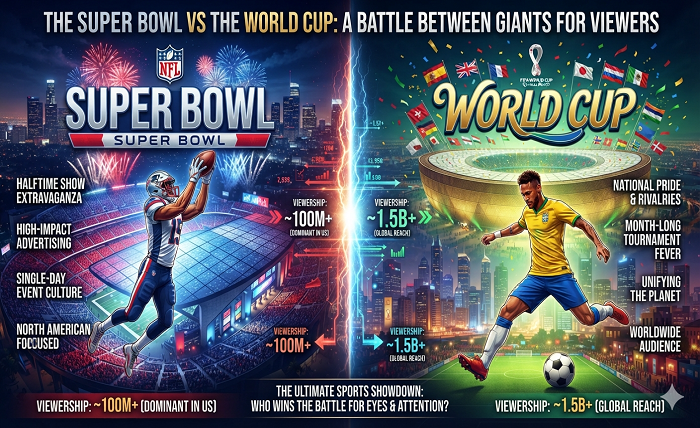
The NFL Super Bowl and the FIFA World Cup: two of the biggest sporting events on the planet. In the US alone, 125.6 million tuned in to watch the New England Patriots versus the Seattle Seahawks. However, globally, the Super Bowl has a long way to compete with the World Cup, which drew in 50 million viewers across the hosting trio of Canada, Mexico, and the USA alone on the opening weekend. Below is a look at the tournaments’ viewing figures, with discussion of why people view one game more than others, the viewing demographics and what could change the viewing figures of both in future.
Discussing the figures
Although the World Cup has a bigger global audience, in the US, the Super Bowl’s 125.6 million viewers meant the event is more popular by a handsome margin. The 2026 World Cup final attracted more than 60 million US and Spanish-language soccer fans to follow the final between Spain and the defending champions, Argentina. Even after the US went crashing out of the tournament, viewing figures remained high.
Analysts have pointed out that these figures could be higher. Group settings, such as watch parties and bars, make it harder to track exactly how many people watch the event. Globally, however, experts expected more than the estimated 1.5 billion who tuned in to the 2022 World Cup final clash between Argentina and France. Five billion across the world were expected to follow the tournament.
Why the preference for one tournament over the other?
One reason for the significant difference in viewing figures is that the World Cup attracts more than traditional sports fans. People tune in to watch the world’s greatest players, including Argentina’s Lionel Messi and Norway’s Erling Haaland. They gather to share a unique experience.
Another reason so many fewer people follow the Super Bowl internationally is that soccer is more accessible. The NFL’s audience is confined mostly to Canada and the USA, whereas, as evidenced by the fact that watch parties took place to follow the World Cup in as far-flung or isolated places such as Antarctica or Tristan da Cunha.
Still, outside of the US, the Super Bowl attracts millions. For instance, more than 62 million viewers outside of the States tuned in for Super Bowl LVIII, where the Kansas City Chiefs beat the San Francisco 49ers.
Even so, the Super Bowl is distinctively American and the biggest in the US sporting calendar. US audiences have a natural affinity for the sport. Fans also like to bet on the game. Sometimes they’re even thinking about the following season’s NFL Week 1 odds, or even the next Super Bowl.
So, who’s watching?
In 2024, Super Bowl LVIII found not just viewers in the US, but also in Canada, Germany, the UK, China, Mexico and Australia. That game was broadcast in more than 100 countries/territories.
Research found that 54% of the Super Bowl audience were men and 75% of viewers were aged between 18 and 34. That doesn’t make it a young person’s sport, however: more than 60% of adults aged 65+ watched the Super Bowl.
As well as English speakers, the World Cup final was followed by Spanish-language speakers, a fact reflected in Spanish-language channel Telemundo’s viewing figures. At the same time, some nations’ opening matches and early ones generated records in several nations, including Mexico, Panama and Canada. Portugal’s opening match captured the attention of almost half the population, and early viewing figures in Asia were also high, especially in Japan and China.
What could change the figures in the future?
In the case of the Super Bowl, access is a big factor. Streaming has been a major factor in how many people follow the Super Bowl. Broadcasting the game on free streaming channels increases access, whereas doing so on paid channels reduces access and viewers.
The star factor is also influential. High-profile stars such as Taylor Swift, who is dating Travis Kelce, achieve crossover interest from viewers who have more interest in the celebrities who attend the events. Meanwhile, on the gridiron, top-level players such as Patrick Mahomes command large audiences just by being in the lineup.
Besides the power of players like Leo Messi to generate attention, the World Cup can experience shifts in viewing figures depending on how well it localizes. A lesson that advertisers learned during the tournament is that US fans show up differently in different cities. Connecting with fans locally is essential. FIFA may also look at how to tap into the phenomenon of watch parties.
The NFL Super Bowl and FIFA World Cup are two of the biggest sports events on the planet and have millions of fans around the globe. The World Cup receives the most views internationally, although the Super Bowl is much more popular within the US. But viewing figures can diminish or increase because of so many factors. Star power, accessibility and localization could all send viewing figures up or down.